Containers: gardening of roof-tops, balconies and terraces
 For many people, gardening takes place on balconies, terraces and rooftops, and there is no access to open soil. In some respects, this makes things easier, as there are fewer limitations imposed by soil conditions. Some plants do better in containers than others. Before buying plants, consider various aspects which will impact on your plant choices, such as wind, amount of sunlight, access to rain water and amount of space.
If there is one golden rule with plants in containers, it is watering. We have made several roof gardens over the years, and in all cases we felt it important to work out the logistics of watering early on. There is no point in going to the considerable effort and expense of buying plants and containers if there is no easy way to water them. Automated irrigation kits can be bought from DIY shops, or make sure you have a decent hose and attachments (never buy one of the commonly available, cheaper brands, as they kink hopelessly and will drive you mad!) If you don't have an outdoor tap on your balcony or rooftop, make sure you have a watering can. Our ready-made scheme of plants suitable for rooftops and balconies is designed to do well in containers, but it will still need watering!
Generally, it is a good idea to plant
in as large a container as possible. This means that you will need to
water less often, plants can grow and mature without running out of
root-space, and plants and containers are more stable in strong winds. It is also worth
buying good compost. Compost known as ‘John Innes’ has a proportion of
sterilsed topsoil and grit in it, and has much better water-retaining
capacity that peat-based composts. Ideally, purchase a mixture of John
Innes compost and a peat-free compost, which is increasingly available
in most garden centres, and also on dyg. This will ensure that your mix is not too
heavy, and will sustain healthy plants for a long period.
Plants in containers, and also those exposed to higher levels of wind,
dry out faster, so it is important to choose plants which can cope
without water for a week or two at a time. Some trees and shrubs such
as Pine, Phormium and Hebe are resilient, while plants with large
surface areas of leaves, such as bamboo, can dry out quickly. The more commonly available species of bamboo, such as Phyllostachys aurea and Phyllostachys nigra can suffer from 'wind burn' (ie the leaves will turn crispy and dry at the edges, and many of them will fall off), especially early in the year around March and April. Bamboos such as Pseudosasa japonica, Pseudosasa japonica 'Tsutsumiana' and Phyllostachys bisettii are better suited for exposed areas and containers. Bear in mind that larger plants with plenty of leaves, such as bamboo, act as a sail in the wind, and require large, solid pots to prevent them from blowing over. For such plants and such environments, we recommend a pot with a square base such as a 50 or ideally 60 cms lightweight terrazzo. The volume of compost is such that the plants will not blow over, not dry out instantly and have enough space to mature into larger plants over several years.
Window boxes are suitable for small-flowering plants such as
summer-flowering annuals or hardy, tough perennials. In this category we would include the very resilient Tulbaghia (which has a rather oniony smell if you brush against it, but lovely, Agapathus-like flowers), Aubretia, Sedum spathyphyllum, Iberis sempervirens or Campanula muralis. However, evergreen plants such as box and
ivy, and bulbs which come back year after year such as daffodil,
require less work. However, all plants growing in containers require
work, in the form of weekly watering (even in wet spells), cutting back
and tidying, and feeding or top-dressing with compost. The best general
feed for plants in containers is a sea-weed based concentrate which is
diluted in the watering can.
A great benefit of gardening in containers is that you can take them
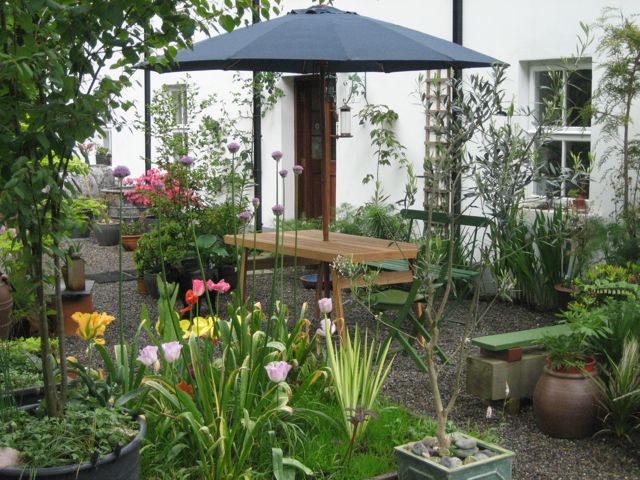
with you when you move on! Anthea and I lived in rented houses for several years, and our garden came with us wherever we went (see the picture above). At last, we have now have our own place, complete with many mature plants which we have had for years. In a rented house there is little incentive
to put plants into the ground. But remember, as plants grow, their pots become too
small for them, and they need to move on to larger ones. Some plants
can cope better than others with this, but if there are plants you grow
attached to, it’s well worth giving them more room so that they will still
be healthy when you eventually find a final resting place for them.