
Natural Irish Paving Materials in Your Garden: Case Study Using Mayo Sandstone Setts (April 2009)
For specialist laying of native irish paving stones, we recommend Irish Stone Gardens: http://www.irishstonegardens.ie/

Smaller gardens may often prove more complex than larger ones. Space is at a premium, and the needs and desires of the client need to be compressed into a smaller area. Per square metre, small gardens get an awful lot of attention! So it was in a recent project of mine. The clients had a long list of requirements which needed to be satisfied; the site had its own peculiarities and requirements; and I had my tastes and opinions which needed to find expression too. It's the combination and distilling of these that is the design process. Please note: We at Howbert and Mays do not sell paving slabs.
The clients were in bad need of somewhere for their three children (all under 4) to play. The small back garden was right off their kitchen-dining room, with large doors leading to it, as well as one very large window. They needed somewhere for a sand-pit, for bicycles and tricylcles, as well as a place for a table where they might dine outdoors in the summer. They also needed access to the back gate on a daily basis, as this is where they most often enter the house from. As to the site, it is at the back of a south-facing, three storey house, and is therefore shady during the winter. It had been laid out as a lawn when I first saw it, with very poor drainage and a tendency to be completely water-logged for weeks on end during wet weather. Being almost two feet lower than the laneway behind meant that, as well as being shady, it was also low-lying. The fact that it is very visible from the well-furnished and attractive main living room of the house meant that it had to look good.
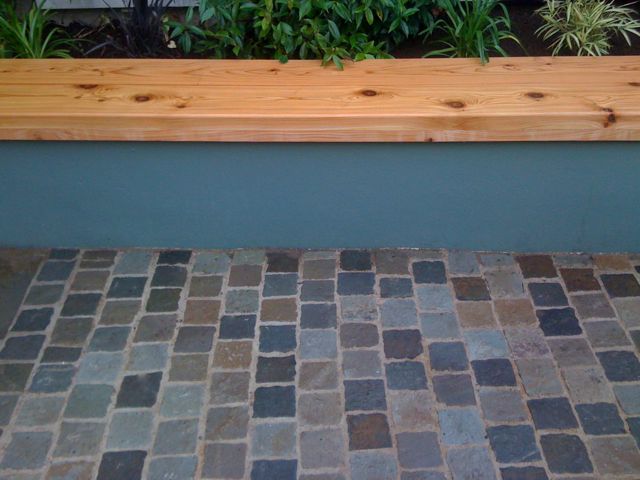
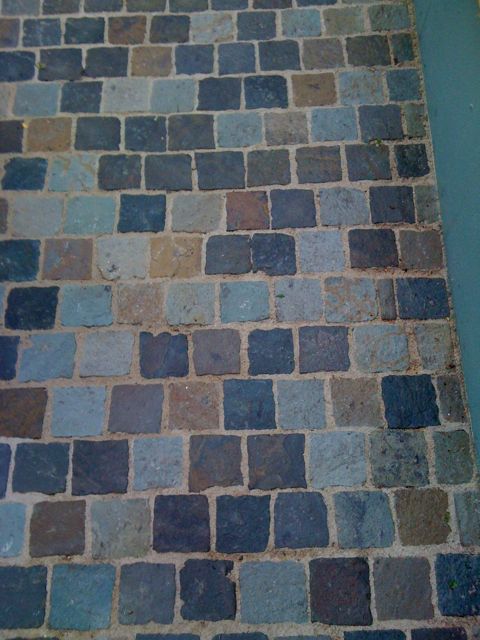
With this as the brief, we went through all the options. I was sure that the grass needed to be got rid of, as it simply cannot take traffic when it's that shady. We ruled out decking - too slippy in such a shady spot; gravel - too tasty for the under fours, and would be thrown about by them; rubber play surface - too much like a playground, and very difficult to get poured as a single piece for such a small area; and paving - with a history of poor drainage, I was reluctant to install something where water could pool. Eventually, I decided upon cobbles or setts, loosely pointed so that they were fully permeable. And although a hard surface, they read somewhat softer than large slabs. The one problem for me was that I don't like to use imported stones. I love the regional characteristics of many of our native stones: Kilkenny, Carlow, Liscannor and Doolin limestones, Wicklow granite, Valentia slate and Mayo sandstone. These wonderful stones all have something special about them, and I have used them over the last few projects. Chosen correctly, these stones age and weather gracefully, developing a patina and actually improving with time. They have travelled only a short distance and I am satisfied that in Ireland we have relatively good environmental, employment, and health and safety legislation. Having used a sandstone from Co Mayo a few times, I contacted the quarry and discussed the possibility of making 10 cms square setts or cobbles. They came up with a way of making them (chopping thick slabs with a guillotine) and a price - we were off. This wonderful sandstone comes in great thick slabs. The colour is variable, from grey to green to ochre. It ages wonderfully, mellowing in tone but not developing any unpleasant algal blooms. Sometimes the slabs are enormous - I normally specify 60 cms wide by random lengths, though other sizes are available. Because the slabs have variable thickness, they need skilled hands to lay them. The slabs retain their natural contours and slightly riven surface, but the edges are cut by saw. I like the edges to be 'dressed' - a process of tapping them gently with a stonemason's hammer to remove the sharp lines; a subtle but invaluable part of the process.
The 'design' was really the process of choosing the plants and materials. There was no drawing necessary - I made a few measurements in my diary. The setts were to cover the main bulk of the garden. The other 'feature' of the garden was a low wall that ran around the edges, capped with travertine and planted with some sickly Azaleas. This has been re-painted and capped with a chunky seat of Western red cedar (Thuja plicata), grown and milled in Co Wicklow. New plants have been put in that are fairly childproof, and also able to grow upwards rather than outwards: the bamboos Fargesia 'Asian Wonder' and Semiarundinaria fastuosa 'Viridis'; the wall-plants, Rosa banksiae 'Lutea' and Ceanothus 'Trewithen Blue'; and some fillers lower down including Agapanthus and Phormium 'Back to Black'. The great drainage challenge has been well tested and proved 100% successful: the setts are laid over a network of drainage pipes, backfilled with drainage pebble and grit. This unseen work made the job more expensive than it might have been otherwise, as several tons of grass, compacted topsoil and builders' rubble had to be removed. However, the garden now looks great, functions well and is well-used by the children.
People often wonder, when I tell them that I like to use Irish paving materials, how I persuade clients to choose them when they cost more. I always take the approach that less of a higher quality product is better than more of an inferior one. Darina Allen was a big influence on me. The Ballymaloe ethos of quality over quantity translates well into other areas, and none more so than our own. So many gardens that I see have too much paved surface in them: far more than necessary. With a well-planned garden you can radically reduce the amount of paved surface, and then choose one that is locally sourced, full of character and good for our economy. I cannot count the number of gardens where the clients have contacted me because they are dissatisfied with their existing paved surface of patio. Just as our food producers and chefs can work wonders, so can our quarries and stonemasons. Please note: We at Howbert and Mays do not sell paving slabs.
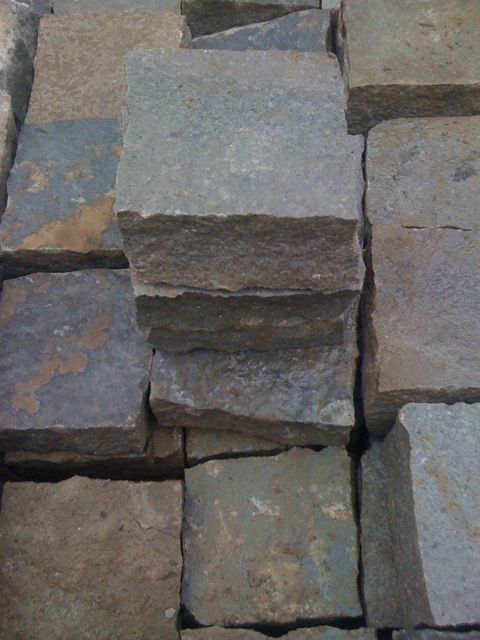
The setts are of different depths, which requires skilled laying
Please note: We at Howbert and Mays do not sell paving slabs.