
Trees and shrubs in the garden
Designing gardens and selling plants has taught us a little about the proportion of different types of plants contained in a garden. For example, a small or medium-sized suburban garden may have 2 or 3 trees, 10 or 12 shrubs, maybe a couple of bamboos, dozens of perennials, grasses and ferns and an infinite number of blades of grass. In other words, a garden will have a small number of big things and big number of small things. It's just like home: there's a big table, a big sofa, a few smaller chairs and stools and then thousands of smaller items such as plates, pens, notebooks, cushions, divided prortionally by size. Just like a home, a garden feels off-balance if the proportions are wrong. A room with a few big items in it, but nothing else, will feel unfurnished in just the same way as the same room would if it contained only small things. It will, in fact, be a heap of mess on the floor. Selling plants has given me a feel for the tree-shrub-smaller-plant balance. When we opened our shop I was surprised by how few people bought trees and shrubs, and by how many flowers we sold. I took me a while to put two and two together and to work out that because trees live for decades, and that every garden can only fit a limited number, there aren't that many of them being bought and sold. Perennials and smaller plants, on the other hand, die out after a few years and there is always room to squeeze in more.
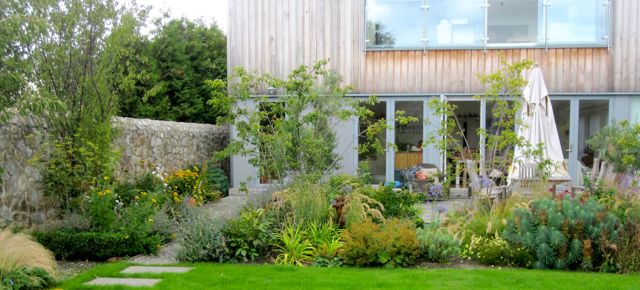
A newly planted bed by Howbert & Mays includes multi-stem Amelanchier and cherries, as well as lower level perennials and grasses.
Gardens are much the same as homes, where differently-scaled objects, whether plants or furniture, relate to each other. There are really three main 'sizes' of plants, or levels in a garden, and when I design a garden or do a garden consultation I always try to think of these levels. The first level - the 'big' things, the equivalent of the table of sofa - are trees. Trees are above eye level. There are big trees, little trees and medium-sized trees, and the choice of tree needs to reflect the size of the garden. In a little garden, a big tree like an oak would dwarf all around it. In a big garden a little tree like a dwarf cherry could be lost. This is why, in suburban areas, medium sized trees such as Birch, Crabapple and Rowan, for example, are so popular. The middle level is plants that are around eye level - sometimes higher, sometimes lower. These are shrubs, climbers or bamboos, and they often provide screening into downstairs room and provide flowers and fragrance. Think Hydrangea, Lilac, Viburnum, Fuchsia, or evergreens such as Hoheria or Myrtle (Luma). At the ground level there is an infinite number of ground-hugging plants or taller grasses and perennials. These abound in flowers and textures and can knit together, reflecting the seasons with bulbs, flowers, coloured foliage etc. A missing 'level' is often the main thing wrong with a garden, and in the Irish case, it's normally the upper level that's most lacking.
In Ireland we seem to have a peculiar fear of trees, especially when anywhere near our homes, and one of the first things to strike me, especially if I have been away for a while, is how treeless and bleak our suburbs can be. Why this is is another discussion: is it that we perceive them to be dangerous; to harbour something fearful: to rob our rare and precious sunlight; to fill our gutters with leaves; to look messy; to damage the foundations or drains? Who knows. But the fact is, many streets are virtually treeless, and many of the trees that we do have are mercilessly hacked every few years, reducing them to hideous skeletons. A well-chosen tree can fit into the tiniest of gardens, and can grow almost adjacent to a house without any adverse effects. For all the talk of 'vertical gardening' and other trends, a tree is nature's vertical garden (as is a climber against a wall). Other countries seem more at ease with trees near their homes. In North America, houses are built under and around trees, with large specimens often overhanging houses. In Germany, you can look from your apartment balcony into the branches of a tree. In Paris, some streets are planted with Robinia, often reaching up five stories, so that the windows open into canopy. In Dublin, there are some beautiful suburban areas that are normally described as 'mature'. This isn't only because the houses are bigger: it's because there are more trees in the gardens or on the pavements.Yes, we have more wind and less sun in Ireland. On the other hand, deciduous trees don't take our light in the winter when we need it most, and many species will cast only a dappled shade. In some cases, it's the fault of planners. In many North American suburbs there is a strip of greenery between the road and the sidewalk. This valuable little strip protects pedestrians from cars and provides the ideal spot for tall trees. Some Dublin roads have this (eg Wellington Road in Dublin 4, that has a grass strip and trees), or Ailesbury Road that has trees but no grass strip. Even small inner-city streets around Portobello have suitably-scaled trees on the sidewalk. But by and large we are shockingly understocked with trees. Howe owners should be braver and no garden should be without a tree and a handful of other plants in varying degrees of smallmness.
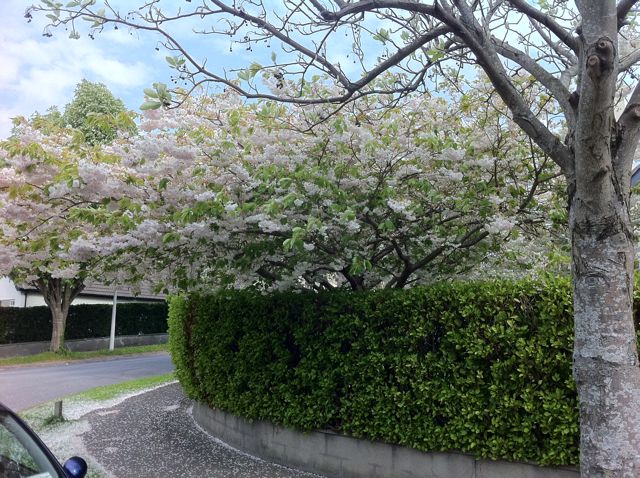
A cherry tree in a garden in Cabinteely, bringing joy and colour to the neighbourhood.
Shrubs, too, are often described as being 'out of fashion'. Roses, Lilacs, smaller Magnolias, Tree paeonies, Weigelas, Philadelphus etc are often described as 'old-fashioned' because they are something that our grandparents may have had. They can look pretty dreadful if planted with nothing else on any other level or clipped into blobs. On the other hand, when part of a multi-layered garden, with a tree above and a matrix of plants at ground level, they can be beautiful. Few plants are easier that flowering shrubs, and many of the most alluring garden scents come from shrubs: Rose, Mock-orange, Lilac. Frequently they are so badly pruned that their chief attribute is all but negated. The commonest mistake is trimming everything into a ball or blob so that both the flowers and the natural shape is lost. If there is one very general tip that I try to give customers buying a shrub, it is to prune from the base. Remove 20 - 30% of branches annually from near ground level, choosing the oldest branches. This works well for many shrubs and keeps their size in check, if necessary, whilst promoting healthy growth from the base, maintaining the natural shape and encouraging flowers.
This year we have compiled a long list of trees and shrubs. Some of them are unusual, some are better known. These are not available to order by 'adding to your cart' on the website. Have a read through, do some research, and then contact us if you would like to order anything. Deliveries will be in early October. You can browse our shorter list of trees at this link and shrubs at this one.
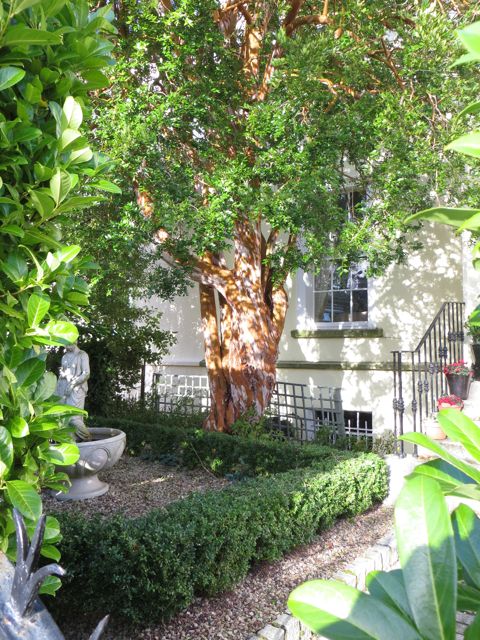
A fabulous Luma apiculata (Chilean myrtle) in a garden in Monkstown, Co Dublin.