
Garden chemicals: why not to use them
Ireland likes to think of itself as a 'green' place: green, as in the Johnny Cash song Forty Shades of Green, but also 'green' in the environmental sense.
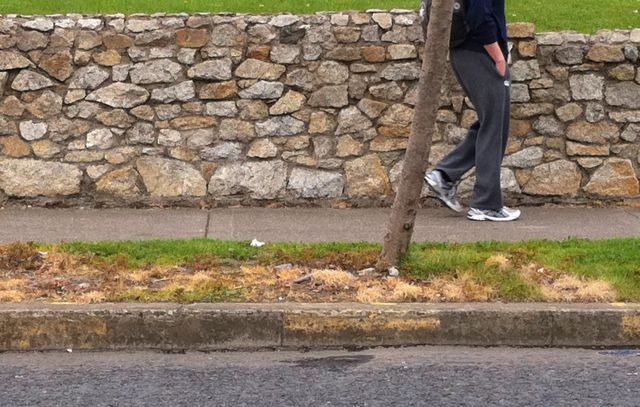
A weed-killed grass verge in South County Dublin. Anywhere deemed difficult to mow is weed-killed.
With so much rain and our mild climate, we have lots of greenery - especially grass. Our fields, hedgerows and verges are very green. You just need to be out of Ireland and then return to realise this. With beef, sheep and dairy farming our bread and butter, grass is a big deal here.
Sadly, there is a new colour in our national pallette: brown. More particularly, an unnatural orange-brown: the distinct colour of weed-killed vegetation. Weed-killer is everywhere in Ireland. On the biggest level, our agricultural land is regularly sprayed with herbicides. The surrounding hedgerows often get a blast too, as do verges and driveways. On a different level, our road edges and median strips are regularly sprayed. On the domestic level, homeowners and gardeners kill weeds in gravel, banks on drives, between plants or in paving gaps. Anyone can spot it. On my daily commute through idyllic County Wicklow - known as 'The Garden of Ireland' - there is evidence of it everywhere: fields near my home, where poisoned grass is ploughed into the ground and re-sown; along the median strip of the N11 where, over a distance of several kilometers, chemical warfare is being waged against Petasites (Heliotrope). The spraying of this plant, invasive as it may be, is on a massive scale and much of it is in the beautiful Glen of the Downs, a designated Special Area of Conservation. Spraying has taken place along streamlets that feed into bigger streams above Delgany. Even the verge and stream bank outside our local garden centre (Glanbia in Ashford), the straem that feeds into the Vartry river at Mount Usher Gardens, has been doused in herbicide. Inside that garden centre a high shelf of Roundup is one of the first things you see.
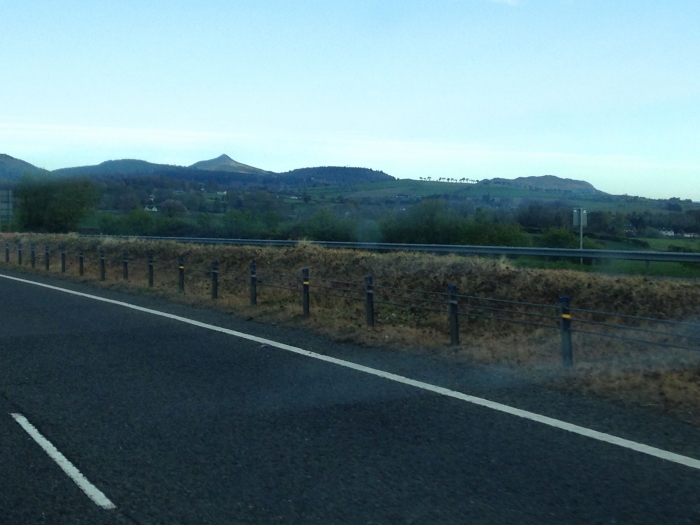
The median strip of the N11 near the Glen of the Downs in Co Wicklow. The eradication of Petasites is the goal of the operation. Shouldn't median strips be free from herbicides and constant mowing? This strip runs for several kilometres and is up to 5 metres wide. Petasites, though unintended, could be more useful than grass in this circumstance, as well as more beneficial to wildlife and requiring less mowing.
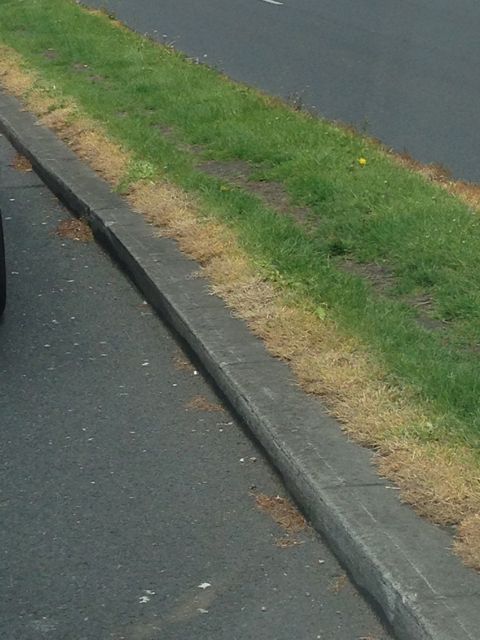
A median-strip in Donnybrook, Dublin 4. Can this really be necessary? Herbicide is expensive to apply, dangerous for the applicator, poisonous for the ground and ugly on the eye. It also sets a bad example.
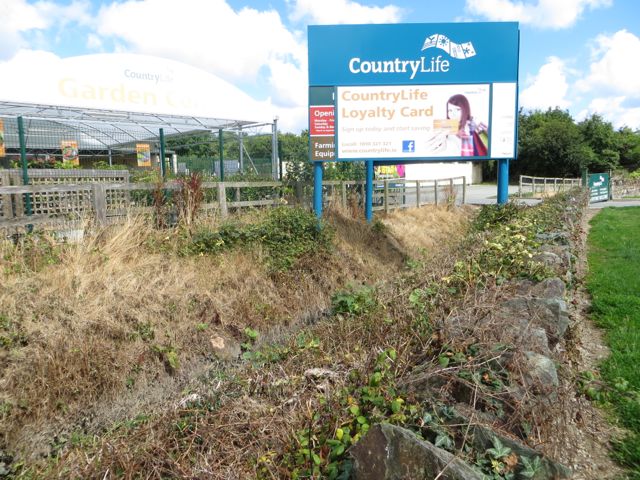
The stream bank and ditch outside the Glanbia garden centre in Ashford, Co Wicklow. A shining example of how and why not to use weedkiller. As well as having made an unsightly mess, the little brook running between the sprayed banks feeds into the Varty river at Mount Usher Gardens.
Herbicide is the technical term for weed-killer. This term can be broken into two parts: herb referring to plants and cide as in to kill. A more accurate name for weed-killer would be plant-killer. The most commonly used ingredient in herbicides is glyphosate, and the most commonly used herbicide is Roundup. Roundup has been inextricably linked to birth defects, cancer, kidney disease, parkinson's disease, infertility and other health issues. Countries including Mexico, Russia and the Netherlands have banned the sale of glyphosate-based weed-killers entirely. Esther Ouwehand, a Dutch member of Parliament who introduced the bill, said:
"Agricultural pesticides in user-friendly packaging are sold in abundance to private persons. In garden centres RoundUp is promoted as harmless, but unsuspecting customers have no idea what the risks of this product are. Especially children are sensitive to toxic substances and should therefore not be exposed to it."
Claims by Monsanto (Roundup's maker) that glyphosate breaks downs harmlessly into the soil have been disproved by many researchers. Quite simply, it doesn't harmlessly disappear: it soaks through the soil and into our water; it gets harvested into our crops and carried into the human food chain; it damages insects and wildlife when applied; it looks terrible, smells nasty and costs a lot. In the arguments against glyphosate weed-killers the main target is always Monsanto. This is a much-despised company, wreaking pollution and entrapping farmers into purchasing genetically modified 'Roundup-ready' seeds (ie seeds that are resiistant to Roundup). With a revenue in 2013 of $14.9 billion it is a mammoth agri-business that has brought much of the world's acreage, and farmers, under its control. It should be said that there are many other companies that now produce glyphosate-based weed-killers, and they should all be avoided for the same reasons.
On the micro-level that is Ireland, and the even more micro-level comprised of our gardens and footpaths, one good argument against herbicides is that they are just downright ugly. No garden should have poison deliberately applied to it, and the burnt orange vegetation is worse than the plants that could have been mown, strimmed or ignored. Gardens should be unpolluted, beautiful and safe. They should be as pleasant for the owners as they are for the worms in the soil and birds in the trees. They can be manicured down to the last blade of grass or allowed to grow wild. The one thing they should not be is filled with chemicals. There has been a 'trickle-down' effect when it comes to garden chemicals. Starting with agriculture, working through public authorities and ending up in our gardens, chemicals work through the soil, into our water and out of our taps.
In Ireland, small and all as we are, we should try our hardest to keep our country green, in both senses of the word. If garden chemicals and herbicides have worked their way from agriculture to domestic use, it should be gardeners who are the first to abandon them and, by default, the garden centre owners the first people to stop selling them. Our garden centre prospers without selling synthetic garden chemicals. There are many tools and potions that can help you to keep your garden as tidy and well-groomed as you desire without having to resort to poison. When people ask for a herbicide we point them in the direction of a gardening tool such as innumerable types of hoes, sickles, slashers, bill-hooks, cultivators, claws, scratchers, forks; a mulch such as bark, slate, manure or compost; or a technique such as sowing a green manure crop, covering with cardboard etc; we also sell a weedkiller that uses plant-derived acids to burn foliage and inhibit re-growth. If people need fertiliser, there is a plethora of them based on natural ingredients such as seaweed, fish, blood and bone, manure or worm casts. Whatever the size or your little bit of earth, it should be treated as the rest of the world should be treated. Whether you have one flower pot or one acre, your treatment of it should symbolise something greater.