
Rus in urbe - bringing the country to new territories
 When I was a student, I lived in the city centre. Time would fly by, and before I knew it I realised that I hadn't left the city for several months. This was in the days before people of my age had cars, or before we even knew anyone who had a car, so it was a Dart out to Killiney Hill or a bike ride along the South Wall if we wanted great open spaces or a dose of fresh air. Luckily, I had a friend whose parents have a farm near Avoca, so very occasional visits there kept me in touch with life outside the big smoke. Now, things are very different for me, and though I am in Dublin city centre two or three days a week, I live in the countryside near Ashford in Co Wicklow. And the longer I live here - luckily for me, in a very beautiful part of Wicklow, surrounded by forest, half in the mountains and half near the sea - the more I appreciate what well-managed woodlands have to offer. There is a great round of bulbs, grasses, ferns, mosses, trees and shrubs, and an equally impressive cycle of decay and regeneration. The more I have got to know it, through constant walks and living in the midst of it all, the more I have felt it provides me with a great sense of the seasons and a great appreciation for the natural processes - as if I were living in a giant garden with no maintenance required.
 Two recent projects have made me want to pay homage to this landscape in radically different settings. The first was in a large suburban garden in Foxrock, extending to about an acre, where a 1930s house was being restored and extended, and the second was in a series of courtyard gardens for a Community Centre in the North inner city, in a development for Dublin Docklands Development Authority.
The client for the house had spent time in Germany and Austria, and liked what he referred to as the 'wild', un-manicured look, so I developed this into a glorified series of woodland glades and thickets. Some existing trees were retained (mainly birch), and many more were planted, though I wasn't strict about using only native plants. We planted several species of birch (Betula pendula, B. nigra, B. 'Fascination', B. utilis 'Jacquemontii'. B. papyrifera....), as well as clusters of Acer japonicum, Clethra alnifolia, Viburnum opulus 'Compactum', Azalea luteum, Calycanthus floridus and so on. Groundcover plants consisted of native and non-native grasses and ferns such as Luzula nivea, L. sylvatica, Carex pendula and Chionochloa flavicans (grasses) and Digitalis, Polystichum setiferum, Hyacinthoides non-scripta and various Narcissus cultivars. All in all, the impression was something between native wild forest and Mount-Usher gardens. For all its apparent naturalness, this garden took a huge amount of maintenance to establish. The grasses and ferns, planted in their hundreds in small 9cms pots / liners, needed time to fill out, and weeds grew well in the meantime. The large amount of bulbs meant hoeing was impossible and most weeding needed to be done by hand. However, now that the garden has got through its second full summer, plants have established sufficiently to look after themselves and suppress too many unwanted invaders, and the solid mat of groundcover has started to knit together. This style of planting looks good in association with the house, and by realigning the driveway, we gave the impression that the house can only be accessed by passing through the midst of this planting, only opening up when you approach the house and see it for the first time when you round a corner in the drive.
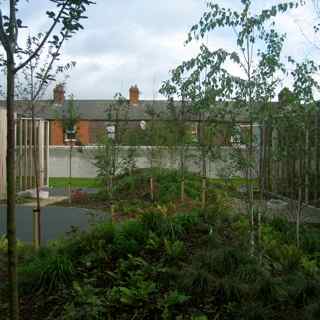
The second case which was inspired by my surroundings was for a Community centre in Dublin's north inner city. The architects, John Tuomey and Sheila O'Donnell, had designed their building around a series of open spaces or courtyards. The building, to be used for various community activities, includes a day-care centre for older people, a crèche and child-care facilities, a theatre, café and other meeting spaces. The building is to a degree inspired by the Louisiana Museum of Art in Denmark, an icon of Modernist architecture by Jørgen Bo and Wilhelm Wohlert. We looked at many images of this building, where the landscape and the building are nicely intertwined, and interpreted it in an Irish context. The gardens are like micro-woodlands, little snippets of greenery which appear to have always been there, as if the building was dropped over pre-existing woodland. We went to great lengths to faithfully reproduce this environment, purchasing tree stumps, logs and rocks from the forest near where I live in Ashford. We even took moss and the weeds that were growing on the stumps, and buried these in the ground so that they would spread any seeds they had in them. Both the topsoil and the gravel are also from this area. Trees were planted at all different sizes to give the impression of the place having evolved over time, and I was quite strict in my choice of plants. Only one or two non-native plants were included, such as a Parthenocissus tricuspidata (Boston ivy) which we wanted for one wall. And rather than keeping any areas level or flat, we created small hillocks and dips, mimicking the natural landscape.
These gardens are primarily to be looked at from the inside, to filter light into the building. They are, of course, accessible, and the largest of them is to function as a children’s play area. I was determined that we shouldn't go down the road of endless play equipment. I was very conscious that the open spaces in this building were precious indeed in this part of Dublin, and should offer some sort of escape to people for whom this was most difficult. We did manage to integrate a semi-circular 'glade' of poured rubber play surface, but even the slide is integrated into a bank of plants, so that children will have to run back up a mulch path, through plants, to access the top of the slide. Apart from the poured rubber surface, which was a requirement from the users of the centre, the only hard landscaping material used was the retaining edges around this area. Conscious of the poor ethical and environmental standards behind the majority of imported sets / cobble stones (I didn't want a 'by children, for children' scenario), we chose salvaged Dublin street cobbles.
This building will open to the public in the New Year. Recently reviewed by Shane O'Toole in the Sunday Times , he commented: 'these miniature woodlands of oak, birch and hazel, encased in minimalist vitrines, must be the most beautiful of any public building in Ireland.' John Tuomey, the architect, pointed out that 'the planting, dense and dark like a forest floor is such a luxury........ yet it was done with less than 1% of the overall budget'.